 ultimate-guide
What Is Inclusive Dental Care? A 2026 Guide
Table of Contents
- What Is an Inclusive Dental Care Approach?
- Barriers to Oral Health Access and Who Faces Them
- Dental Care for Special Needs Patients: Clinical Accommodations That Work
- Managing Dental Anxiety and Trauma With Trauma-Informed Care
- Neurodivergent-Friendly Dental Care and Sensory-Friendly Offices
- Financial Accessibility and Insurance Navigation
- Patient Advocacy, Rights, and Inclusive Communication
- Conclusion: Building an Inclusive Practice and Finding One
- Frequently Asked Questions
Last Updated: September 11, 2026
What Is an Inclusive Dental Care Approach?
Inclusive dental care is a patient-centered approach that adapts treatment, communication, and the clinical environment to meet the needs of every patient, regardless of disability, neurotype, income, or past trauma. This guide explains what the approach involves, who it serves, and how to find a practice that genuinely delivers it.
The core idea is straightforward: instead of expecting patients to fit a fixed clinical routine, an inclusive practice reshapes that routine around the person in the chair. That can mean longer appointment blocks, written communication for patients who find verbal instructions hard to retain, or quiet rooms for patients who find sensory input overwhelming.
How It Differs From Standard Dentistry
Standard dentistry is built around efficiency: short appointments, standardized scripts, and a one-size-fits-all treatment room. An inclusive dental care approach keeps the same clinical standards but changes how care is delivered. Appointments run longer. Providers ask about triggers and communication preferences before treatment starts. The physical space, lighting, sound, and pacing all become adjustable variables rather than fixed ones.
The difference shows up in small details. A standard practice asks, "Are you ready for your cleaning?" An inclusive practice asks what helps you feel steady, and then builds the visit around that answer.
Barriers to Oral Health Access and Who Faces Them
Access barriers fall into four broad categories: cost, physical accessibility, communication, and fear. Each one compounds the others. A patient who cannot afford treatment may also avoid booking because the last visit was painful or rushed, and that avoidance deepens the problem over time.
Health Canada's oral health resources notes that oral health is closely tied to overall health, which makes these barriers a public health issue rather than a personal failing.
Social Determinants of Health and Marginalized Populations
Income, employment status, housing stability, and immigration status all shape how often someone sees a dentist. Marginalized populations, including Indigenous communities, newcomers, and people living on low incomes, face higher rates of untreated dental disease and longer waits for care. Addressing oral health equity means recognizing that transportation, childcare, and time off work are clinical variables, not background noise.
Dental Care for Special Needs Patients: Clinical Accommodations That Work
Dental care for special needs patients works best when accommodations are planned before the appointment, not improvised during it. The clinical evidence and practitioner experience point the same way: predictability reduces distress, and distress reduction is what allows treatment to actually be completed rather than abandoned mid-procedure.
Pre-Visit Planning
The single highest-leverage step is a pre-visit intake that captures four things: communication method, sensory triggers, physical transfer needs, and consent capacity. A one-page form is enough. Ask the patient or caregiver to describe:
- How the patient communicates (speech, sign, AAC device, writing, gestures)
- What calms them and what escalates them
- Whether they use a wheelchair, walker, or need transfer assistance
- Who can legally consent, and whether a substitute decision-maker is involved
This information shapes the appointment before the patient arrives. It also flags when a longer block, a quieter room, or a specific staff member should be assigned.
Scheduling and Visit Structure
Shorter visits split across multiple sessions outperform single long appointments for many patients with cognitive, developmental, or sensory disabilities. A common pattern is to separate the exam, the cleaning, and any restorative work into distinct visits so no single appointment exceeds the patient's tolerance window. The first visit may be a tour only, no treatment, no instruments, just the room, the chair, and the faces.
Consistency matters more than speed. Assigning the same hygienist and the same room each visit removes variables the patient has to re-process. Where that is not possible, a written or visual schedule sent ahead of time gives the patient a script to follow.
Communication and Consent
For patients with cognitive impairment or speech impairment, a caregiver can stay in the room and help confirm comfort and consent. Consent is not a one-time signature. It is an ongoing check, before the chair reclines, before the bib goes on, before any instrument enters the mouth. A stop signal the patient controls (a raised hand, a squeeze ball, a word) should be agreed on at the start and honored immediately, every time.
Written or visual instructions after the visit matter as much as during it. Verbal aftercare instructions are frequently not retained, especially for patients with memory or processing differences. A short printed summary with pictures, or a photo of the patient's own teeth with notes, travels home and gets used.
Physical and Clinical Accommodations
- Wheelchair-accessible chairs and transfer aids, or treatment in the patient's own wheelchair where clinically appropriate
- Mouth props and bite blocks for patients who cannot hold their mouth open voluntarily
- Suction and positioning adjustments for patients with swallowing differences
- Shorter instrument sequences and frequent breaks
- Caregiver present or nearby, with a clear role
Documentation and Coordination
Accommodations should be recorded in the patient's chart so they carry forward to every future visit and every provider in the practice. Where the patient sees multiple specialists, a physician, an occupational therapist, a behavior analyst, a signed release allows the dental team to coordinate. This is not bureaucracy; it is what prevents the patient from having to re-explain their needs at every appointment.
What Does Not Work
Rushing, sedation as a first resort, and treating the disability as the problem rather than the environment as the adjustable variable. Sedation has a role, but it should be a considered clinical choice, not a substitute for accommodation. Patients who are physically restrained or held down for routine care often develop lifelong dental avoidance, which converts a manageable appointment into an emergency years later.
Managing Dental Anxiety and Trauma With Trauma-Informed Care
Trauma-informed care starts from the assumption that a patient may have had a distressing dental experience, and it removes the pressure to explain it. The practical tools are a stop signal the patient controls, an explanation before every instrument touches their mouth, and an agreement that nothing proceeds without consent. Managing dental anxiety and trauma is not about calming someone down. It is about giving them back control of the appointment.
A common mistake is treating anxiety as something to push through. Patients who feel rushed or dismissed usually do not return, which turns a manageable problem into an emergency years later.
Neurodivergent-Friendly Dental Care and Sensory-Friendly Offices
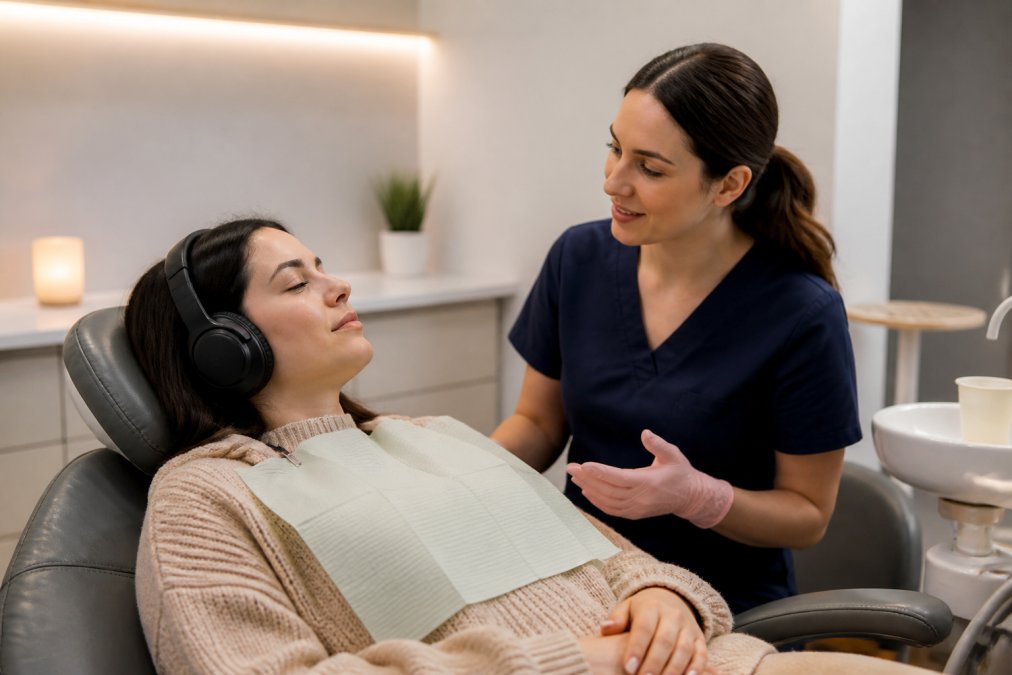
Neurodivergent-friendly dental care adjusts the sensory environment as much as the clinical sequence. Most guides stop at "dim the lights and offer headphones." The practical detail, what actually changes in the room, is where a practice either works for neurodivergent patients or does not.
Why the Environment Matters More Than the Procedure
For patients with autism, ADHD, sensory processing differences, or anxiety, the clinical procedure is often not the hardest part. The waiting room, the overhead fluorescent hum, the smell of eugenol, the unexpected touch of a bib clip, these are the inputs that overwhelm before treatment begins. A sensory-friendly office treats those inputs as design variables, not fixed conditions.
Lighting
- Replace or bypass overhead fluorescent panels with dimmable, warm-toned lighting
- Use floor or table lamps for task light rather than ceiling light
- Offer tinted or polarized glasses for patients sensitive to glare
- Avoid flickering or buzzing fixtures, which are common triggers
Sound
- Mute or lower equipment beeps where the model allows
- Use acoustic ceiling tiles or panels to reduce echo and the whine of handpieces
- Offer noise-cancelling headphones or ear defenders, and let the patient keep them on
- Play predictable, low-volume background sound or allow the patient to bring their own
- Announce loud sounds before they happen ("the suction is about to start")
Smell and Taste
- Choose unscented cleaning products and avoid air fresheners
- Offer a choice of unflavored or mild-flavored polish and fluoride
- Keep a neutral-tasting rinse available as an alternative
Touch and Physical Comfort
- Offer a weighted lap pad or blanket
- Let the patient keep a comfort item or fidget tool in their hands
- Warn before any physical contact, and narrate each step
- Allow the patient to sit up, walk around, or take a break at any point
Layout and Waiting Area
- Provide a quiet waiting space separate from the main reception, or a low-traffic corner
- Reduce visual clutter: fewer posters, no flashing screens, no strong patterns
- Offer a visual schedule of the visit posted in the room or handed to the patient
- Keep the path from door to chair predictable and unobstructed
Predictability Over Speed
For patients with ADHD or autism, predictability matters more than speed. The same room, the same order of steps, and a clear signal before each one reduce the cognitive load of the visit. A practice that runs on time is helpful, but a practice that runs in the same order every time is what makes return visits possible.
What to Ask Before You Book
If you are seeking neurodivergent-friendly care, ask the front desk directly:
- Can I see the room before my appointment?
- Can I request the same hygienist each visit?
- What lighting and sound options do you have?
- Is there a quiet place to wait?
- What happens if I need to stop mid-appointment?
A practice that can answer these plainly is signaling that accommodations are built into how it operates, not improvised per patient.
Financial Accessibility and Insurance Navigation
Cost is the barrier patients mention most often, and it is the one practices can address most directly. Transparent estimates before treatment, itemized quotes, phased treatment plans, and clear explanations of what a government dental program covers all reduce the fear of an unexpected bill. In Canada, the Canadian Dental Care Plan (CDCP) helps eligible residents with the cost of dental care; eligibility rules and covered services are set by the federal government, so check the official Canadian Dental Care Plan page for current details rather than relying on secondhand summaries.
If you do not have insurance, ask three questions at the front desk: what will this cost in total, what happens if the treatment plan changes, and what can be staged over several visits. A practice that answers those plainly is telling you how it handles money before you are in the chair.
Patient Advocacy, Rights, and Inclusive Communication
You have the right to understand your treatment, to ask why a procedure is recommended, and to decline it. Inclusive communication supports that: plain-language explanations, written treatment summaries, interpretation services where available, and enough time to ask questions without feeling rushed. Patient autonomy is not a courtesy a practice extends. It is the baseline.
The Canadian Dental Association provides public resources on oral health and what to expect from care, which can help you prepare questions before an appointment.
| Barrier | What It Looks Like | Practical Fix |
|---|---|---|
| Cost | Fear of an unexpected bill | Written estimate and phased plan |
| Sensory | Harsh light, loud equipment | Dimmed lighting, headphones, quiet room |
| Communication | Instructions not retained | Written summaries, caregiver present |
| Fear | Past painful or rushed visit | Stop signal, consent at each step |
| Access | Travel, childcare, time off work | Longer blocks, flexible scheduling |
Conclusion: Building an Inclusive Practice and Finding One
The gap between practices that claim to be welcoming and those that actually are comes down to systems, not sentiment. Longer appointments, written communication, sensory adjustments, and transparent pricing are choices a practice makes deliberately. Pearly Curve Dentistry offers comprehensive, modern dental care designed to help every patient achieve a healthier, more radiant smile. Our practice combines advanced treatment techniques with expert support, ensuring a comfortable and personalized experience for all who walk through our doors. We are dedicated to your long-term oral health, providing trustworthy and supportive care that makes us stand out in the community. Book an appointment with Pearly Curve Dentistry and start with a conversation about what makes a visit work for you.
Frequently Asked Questions
What defines an inclusive dental care approach?
An inclusive dental care approach adapts every part of the visit to the patient rather than expecting the patient to adapt. It covers accessible infrastructure, sensory-friendly offices, trauma-informed care, cultural competency, and equitable access to preventive oral care. The goal is patient-centered care that removes accessibility barriers for people with disabilities, anxiety, neurodiversity, or limited finances. It is a multimodal framework, not a single technique, and it applies to booking, communication, clinical accommodation, and follow-up.
How do dental practices accommodate patients with sensory sensitivities?
Sensory-friendly offices often reduce fluorescent lighting, lower noise, offer weighted blankets or headphones, and schedule longer appointments with breaks. Clinicians explain each step before it happens and agree on a stop signal so the patient controls the pace. For neurodivergent-friendly dental care, some practices also provide a quiet waiting area away from the main reception. These adjustments are low-cost and make a real difference for patients with autism, ADHD, or anxiety.
Why is inclusive dentistry important for patients with dental anxiety?
Dental anxiety keeps people away until pain forces them in, which usually means more complex and costly treatment later. Trauma-informed care addresses this by prioritizing patient autonomy, explaining procedures clearly, and never rushing. When a practice treats anxiety as a legitimate clinical factor rather than an inconvenience, patients attend more regularly and preventive strategies actually work. That improves long-term oral health and reduces the need for emergency care.
How can dental offices improve accessibility for diverse patient populations?
Start with physical access: clear doorways, accessible washrooms, and seating that works for mobility devices. Then address communication with interpretation services, plain-language materials, and staff trained in cultural competency. Financial accessibility matters too, so offer transparent estimates and help patients understand what their insurance or public programs cover. Finally, invite feedback from patients in marginalized populations and act on it. Inclusive policy only counts when patients feel it during the visit.
What role does the Ontario Dental Association play in special needs dentistry?
Dental associations represent dentists and provide continuing education, practice resources, and guidance on treating patients with diverse needs. Regulatory bodies oversee the practice of dentistry. For patients, the practical takeaway is that dentists have access to training and standards on special needs dentistry, so it is reasonable to ask a practice what specific experience and accommodations they offer.
I have ADHD and struggle with oral hygiene. Will a dentist judge me?
A practice that follows an inclusive dental care approach should not shame you. Tell the team upfront about your routine challenges so they can suggest realistic preventive oral care, such as habit stacking, a visible toothbrush, or short two-minute timers. The appointment is a chance to problem-solve together, not a test. If a dentist makes you feel worse, that is a sign the practice is not patient-centered care and you are entitled to seek another provider.
How do I ask a dental office whether they are actually inclusive?
Ask specific questions before booking: Do you offer longer appointments for anxious patients? Can I see the treatment room first? Do you have headphones or a quiet waiting area? How do you explain costs before starting? What experience do you have with special needs dentistry? Concrete answers reveal whether inclusion is real or just marketing. You can also ask about accessible infrastructure and whether the team has training in trauma-informed care.
What if I do not have dental insurance? Are there options?
Many practices offer payment plans or can provide a written estimate before treatment so there are no surprises. In Canada, the Canadian Dental Care Plan (CDCP) is a federal program that helps eligible residents with the cost of dental care. Eligibility and covered services are set by the government and can change, so check the official CDCP website for current details. If you do not qualify, ask the practice directly about flexible payment options and preventive care that fits your budget.