 how-to
Managing Dental Fear Without Sedation
Table of Contents
- What You'll Need Before You Start
- Understanding Dental Fear and Why It Happens
- How to Tell Your Dentist You Are Anxious
- Breathing Exercises for Dental Appointments
- Distraction Techniques for Dental Procedures
- Building a Sensory-Friendly Dental Environment
- Cognitive and Mind-Body Approaches to Dental Fear
- Conclusion
- Frequently Asked Questions
Last Updated: September 14, 2026
What You'll Need Before You Start
Managing dental fear without sedation starts with preparation, not willpower. At Pearly Curve Dentistry, we see patients every week who have avoided care for years, and the ones who cope best are the ones who arrive with a plan. Before your next appointment, gather four things: a written list of your triggers, a phrase you can say out loud to pause a procedure, a breathing technique you have already practiced at home, and a way to signal your dentist without speaking. None of these require a prescription or a sedative. They require rehearsal.
The first practical asset worth building is a trigger list. Write down what specifically unsettles you: the sound of the drill, the taste of impression material, the feeling of reclining flat, the sight of the needle. Vague dread is harder to manage than a named trigger, because you cannot plan around something you have not identified.
Understanding Dental Fear and Why It Happens
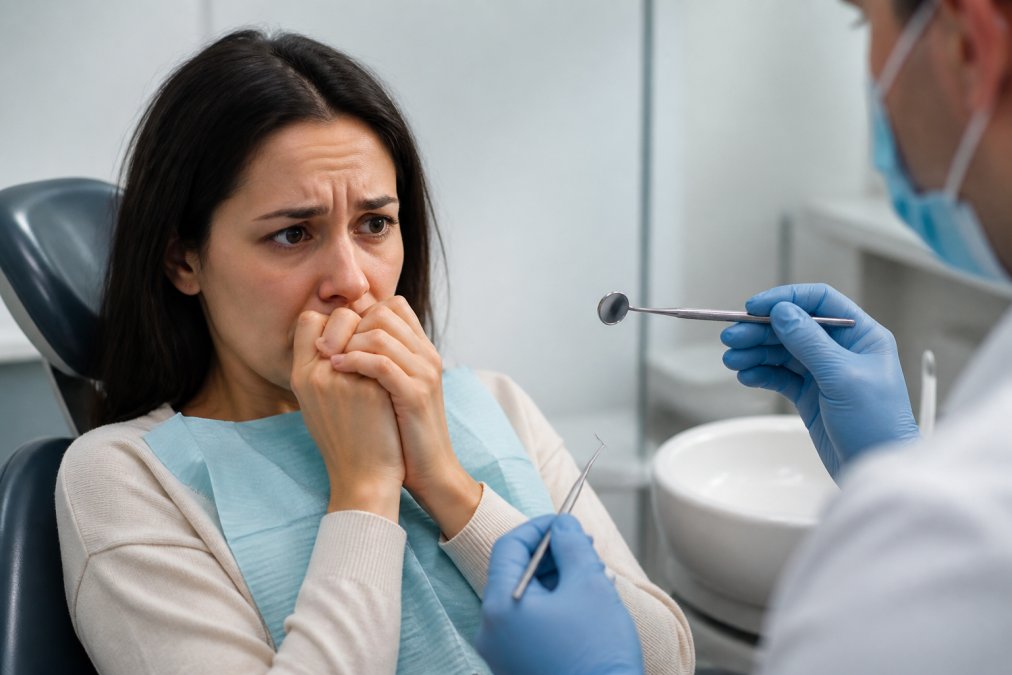
Dental fear is a learned stress response, not a character flaw. It develops when the brain links dental settings with pain, loss of control, or embarrassment, and it activates the autonomic nervous system before any treatment begins. Dentophobia, the more intense form, can trigger avoidance so complete that patients skip care for a decade or more.
The causes cluster into a few recognizable patterns:
- Previous painful or rushed treatment, especially in childhood
- Needle phobia or a strong gag reflex
- Fear of judgment about oral hygiene, which many patients describe as worse than the physical discomfort
- Sensory overload from bright lights, strong smells, and unfamiliar sounds
- Loss of control when reclined and unable to speak clearly
The Canadian Dental Association's patient resources note that anxiety about dental visits is common and treatable, and that patients should feel able to discuss it openly. That last point matters. Fear that stays unspoken is fear your dentist cannot work around.
How to Tell Your Dentist You Are Anxious
Say it early and say it plainly. The most effective approach is to mention your anxiety when you book the appointment, not when you are already in the chair with instruments laid out. This gives the practice time to schedule a longer visit, assign a clinician suited to anxious patients, and plan a stress-free visit rather than improvising one.
Use language that names the specific problem. "I have dental fear and I need you to tell me before you start each step" works better than "I'm a bit nervous." Specific requests give your dentist something to act on.
- Ask for a agreed stop signal, such as raising your left hand
- Request that the chair be kept more upright if reclining bothers you
- Ask for a plain-language explanation of each step before it happens
- Confirm you can pause the appointment at any point
A useful framing for the conversation is patient autonomy: you are not asking for a favour, you are stating a clinical preference. Most practices, including ours, treat that as routine information rather than an inconvenience.
Breathing Exercises for Dental Appointments
Slow, controlled breathing is the fastest non-pharmacological way to calm the autonomic nervous system in a dental chair. The technique that works best for most patients is a 4-6 pattern: inhale through the nose for a count of four, exhale slowly through the mouth for a count of six (Slow breathing for reducing stress: The effect of extending exhale). The extended exhale is what triggers the calming response.
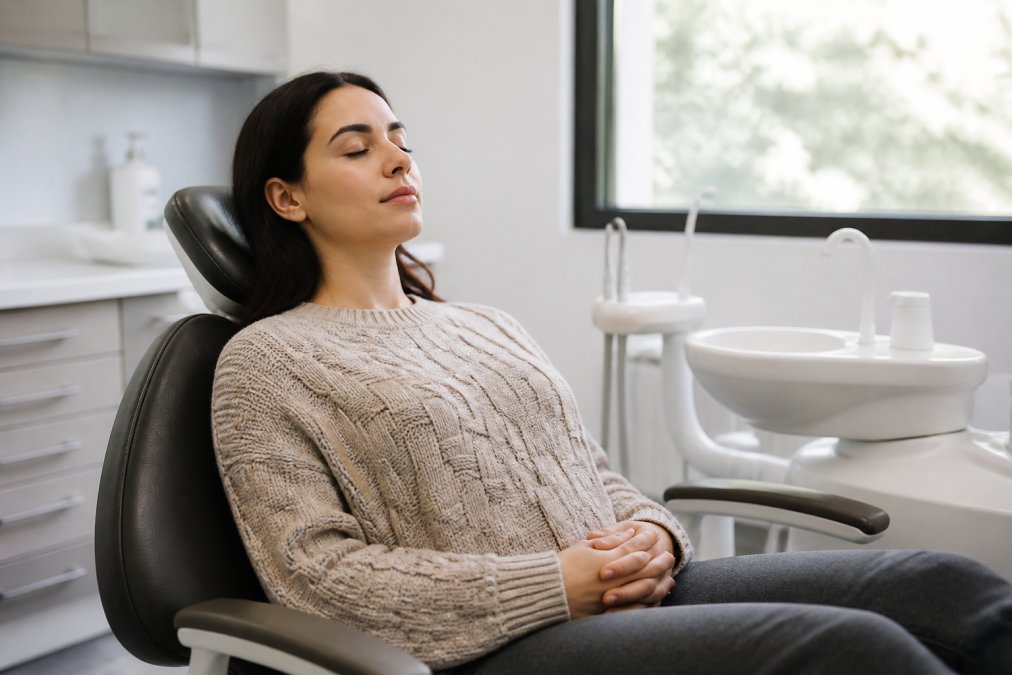
Run the cycle for two minutes before the dentist begins, and again during any pause. If you wear a nasal mask or have a blocked nose, switch to a 4-4 count through the mouth. Pair the breathing with progressive muscle relaxation: tense your feet for five seconds, release, then work upward through your calves, thighs, and shoulders. The physical release interrupts the tension that builds during long procedures.
Distraction Techniques for Dental Procedures
Distraction works because attention is a limited resource. If your mind is occupied, it has less capacity to monitor and amplify discomfort. The most reliable distraction techniques in a dental setting are the ones you control, not the ones imposed on you, and they have to be set up before the procedure starts, because deciding to distract yourself mid-drill rarely works.
- Audio: Noise-cancelling headphones with a familiar podcast or playlist. Ask your dentist to tap your shoulder before speaking so you are not startled. Familiar content beats new content, because novelty pulls attention back to the room.
- Visual: A fixed point on the ceiling, or a screen if the practice offers one. Guided imagery, picturing a specific place in sensory detail, works better than vague daydreaming because it demands more working memory.
- Tactile: Squeeze a soft stress ball in one hand. The physical focus competes with the dental sensation, and it gives you something to do with the tension that builds in your hands.
- Cognitive: Count backward from 300 in sevens. It is dull enough to be calming and demanding enough to occupy working memory.
Reducing the Triggers, Not Just the Attention
The deeper strategy is to reduce the need for distraction in the first place. Two of the most common triggers, the needle and the drill, can often be avoided or minimized with technology that many practices now offer. Air abrasion uses a stream of fine particles to remove decay without the vibration and sound of a drill, which makes it useful for small cavities and for patients whose fear is tied to the drill itself. Dental lasers can be used for some soft-tissue procedures and small fillings with less noise and, in some cases, less need for local anesthetic. Topical anesthetic applied before an injection reduces the sting of the needle itself, and a slower injection technique reduces the pressure that many patients describe as the worst part.
None of these eliminate every trigger, and not every practice offers all of them. But asking at booking, "Do you offer air abrasion or laser treatment for small cavities?", tells you whether the practice is set up for anxious patients or just willing to accommodate them. It also shifts the conversation from managing fear to reducing the things that cause it.
After the Appointment
Most guides stop when the procedure ends. That is a mistake, because the memory you carry out of the room is what shapes how you feel about the next visit. A short post-appointment ritual helps consolidate a calmer association:
- Debrief while it is fresh. On the way home, note one thing that went better than you expected. It does not have to be big, the injection was quicker than you remembered, or you used your stop signal and it worked.
- Write down what helped. Keep a running note on your phone: which breathing pattern, which playlist, which request to the dentist made the biggest difference. Bring it to the next visit.
- Plan the next step before the fear fades. Booking the follow-up while you are still in the calm afterglow is easier than waiting until dread rebuilds.
- Name what you would change. If the light was too bright or the chair too flat, note it and ask for the adjustment next time. Small environmental fixes compound.
This is the part competitors miss: managing dental fear without sedation is not a single appointment skill. It is a loop, prepare, cope, debrief, adjust, that gets easier each time you run it. Patients who debrief tend to need less distraction at the next visit, not more.
Building a Sensory-Friendly Dental Environment
A sensory-friendly dental environment is one where the patient controls as much of the input as possible. This matters most for patients with sensory sensitivities, but it helps anyone with dental fear. Ask your practice what they can adjust, and treat the following as a checklist to run through at booking.
- Dimmed overhead light, with the operating light angled away from your eyes
- Unscented or fragrance-free products in the treatment room
- A weighted or heavy blanket across your lap for grounding
- Sunglasses or an eye mask to reduce glare
- A agreed hand signal to pause at any point
- A quiet room away from the main waiting area, if available
- Earplugs or headphones to soften drill and suction noise
At Pearly Curve Dentistry, patients are welcome to bring their own headphones, blanket, or comfort item, and to request a quieter appointment time. Small environmental changes often do more for anxiety than any single technique.
Cognitive and Mind-Body Approaches to Dental Fear
Psychotherapeutic interventions address the root of dental fear rather than its symptoms, and they are the most durable option for patients with long-standing anxiety. Cognitive behavioral therapy is the best-supported approach, and it works through a specific mechanism: it targets the catastrophic appraisal that fires before a visit, the automatic thought that a twinge means a root canal, or that a pause in treatment means something went wrong (pubmed.ncbi.nlm.nih.gov). A therapist helps you catch that thought, test it against what actually happened at past appointments, and replace it with an accurate prediction. Over several sessions, the brain stops treating the dental chair as a threat before you arrive.
Exposure therapy runs on the same learning principle, but through behavior rather than thought. The feared steps are ranked from least to most frightening and worked through in small, controlled doses, sometimes starting with nothing more than sitting in a waiting room for ten minutes and leaving. The goal is not to feel calm; it is to learn that the feared outcome does not occur, which is what extinguishes the fear response.
Other mind-body methods worth knowing, and what each actually does:
- Mindfulness: observing sensations, pressure, vibration, the taste of gloves, without labeling them as dangerous. It interrupts the panic spiral by keeping attention in the present rather than on the next step.
- Biofeedback: using a device to watch your own heart rate or breathing in real time, then learning to slow it deliberately. It gives you visible proof that you can influence your own nervous system, which is often the missing piece for patients who feel powerless in the chair.
- Systematic desensitization: ranking feared steps from least to most frightening and working through them over several short visits. It is essentially exposure therapy paced by the patient rather than the clinician.
- Guided imagery: a structured mental rehearsal of a calm, specific place, described in sensory detail. It works better than vague daydreaming because specificity occupies working memory.
A dentist can support these approaches by pacing treatment, but the therapeutic work usually sits with a psychologist or therapist. In practice, that means asking your dentist whether they can coordinate with a mental health professional, or whether they can simply structure your visits as graded exposure, a short meet-and-greet with no treatment, then a cleaning, then a filling. Many practices will do this if you ask at booking.
One pattern worth naming: patients who transition from pediatric to adult care often find old fear reopens when they change practices, because the trust built with a childhood dentist does not transfer. Rebuilding it deliberately, through predictable visits, the same clinician each time, and a shared plan, is what makes the difference. The therapeutic alliance between patient and clinician, built over repeated low-stakes appointments, does more for long-standing fear than any single technique.
Conclusion
Dental fear responds to preparation, not avoidance, and the patients who do best are the ones who arrive with a trigger list, a rehearsed breathing pattern, and a dentist who knows what they need before treatment begins. If you have been putting off care, the first step is a conversation, not a procedure. At Pearly Curve Dentistry, we offer modern treatments, expert support, and comfortable care. We are dedicated to your long-term oral health, providing trustworthy and supportive care. Book an appointment with Pearly Curve Dentistry and take the first visit at your own speed.
Frequently Asked Questions
How can I calm my nerves before a dental appointment?
Start by preparing the night before: get enough sleep, avoid caffeine, and eat a light meal. On the day, try deep breathing or progressive muscle relaxation in the waiting room. Tell your dentist you are anxious so they can adjust their approach. Bringing headphones or a stress ball can also help. Remember that dental fear is common and your care team is trained to support you.
What are non-pharmacological ways to manage dental anxiety?
Non-pharmacological methods include cognitive behavioral therapy (CBT), exposure therapy, systematic desensitization, mindfulness, guided imagery, biofeedback, deep breathing, and distraction techniques. These approaches help you regain a sense of control and reduce autonomic nervous system arousal without medication. Many patients find that combining several techniques works best for managing dental fear.
Can dental anxiety be overcome without sedation?
Yes, many people successfully manage dental fear without sedation using a combination of psychological strategies, communication with their dentist, and gradual exposure. Techniques like CBT, breathing exercises, and distraction can be highly effective. However, if your anxiety is severe, discuss all options with your dentist. They can help you decide what approach is safest and most comfortable for you.
How do I communicate my dental fear to my dentist?
Be direct: tell your dentist you feel anxious and describe what specifically worries you (e.g., needles, drills, pain). You can use a scale from 1 to 10 to rate your fear. Ask about stop signals, such as raising your hand, and request explanations before procedures. Good dentists will welcome this information and adjust their care to help you feel more at ease.