 how-to
How to Choose a Cosmetic Dentist in Toronto: 2026 Guide
Table of Contents
- Start With Credentials: Licensing and the Royal College of Dental Surgeons of Ontario Dentist Search
- Questions to Ask a Cosmetic Dentist Before You Commit
- Your Cosmetic Dentistry Consultation Checklist: What to Bring and What to Watch For
- Evaluate Training, Technology, and the Range of Procedures Offered
- Reading Before-and-After Portfolios and Patient Reviews the Right Way
- Long-Term Maintenance, Aftercare, and Financing Transparency
- Frequently Asked Questions
Last Updated: September 16, 2026
Start With Credentials: Licensing and the Royal College of Dental Surgeons of Ontario Dentist Search
Choosing a cosmetic dentist in Toronto starts with one non-negotiable step: confirming the dentist is licensed in Ontario. The Royal College of Dental Surgeons of Ontario (RCDSO) licenses dentists, sets standards of practice, and handles complaints province-wide. At Pearly Curve Dentistry, we tell every patient the same thing: credentials first. A beautiful portfolio means nothing if the person behind it isn't accountable to a regulator.
How to Verify a Dentist's Licence Step by Step
Verification takes about five minutes:
- Go to the RCDSO public register and enter the dentist's full name.
- Confirm the licence status reads "General" or "Specialist" and is current, not suspended.
- Check the "Practice Information" tab for the clinic address and any conditions on the licence.
- Read the "Discipline History" section for past findings or cautions.
- Cross-reference the dentist's name against the clinic's website listing.
Most patients skip step four, checking discipline history is the fastest way to rule out a provider.
Questions to Ask a Cosmetic Dentist Before You Commit
The questions to ask a cosmetic dentist should cover training, treatment planning, and what happens if something goes wrong. Watch how the dentist handles a question they can't answer on the spot, a confident clinician says "let me check that" rather than guessing.
Bring these to your first meeting:
- How many of this specific procedure have you performed in the last year?
- Which continuing education courses have you taken in aesthetic dentistry?
- What does your treatment plan look like if I need a crown replaced in five years?
- Who handles complications, and what's the follow-up schedule?
- Can I see before-and-after photos of cases similar to mine?
Your Cosmetic Dentistry Consultation Checklist: What to Bring and What to Watch For
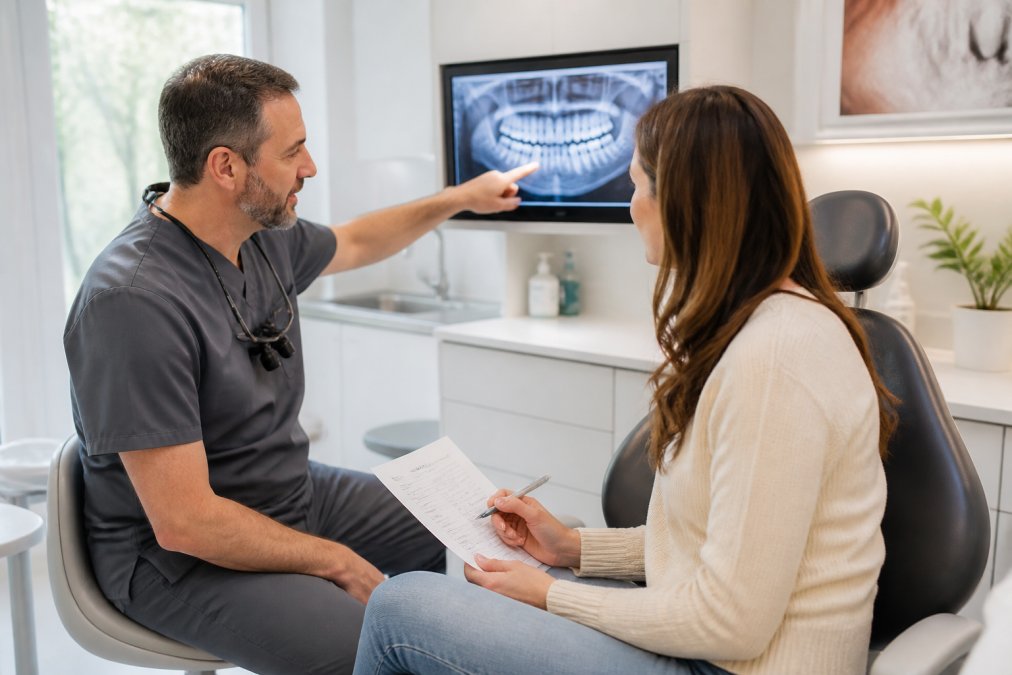
A cosmetic dentistry consultation checklist keeps the appointment focused and gives you a written record to compare providers. Bring your dental history, current medications, prior X-rays or records, and insurance details including annual maximums and cosmetic coverage.
What to bring:
- Your dental health history and a list of current medications
- Recent X-rays or records from your previous clinic, if available
- Insurance policy details, including annual maximum and exclusions
- A written list of your aesthetic goals and any specific concerns
- Photos of smiles you like, if you have them saved
What to watch for during the appointment:
- The dentist examines your teeth and gums before discussing cosmetic options
- You receive a written treatment plan with itemized costs
- The dentist explains risks, alternatives, and what happens if you do nothing
- You're given time to think, not asked to sign on the spot
- Digital imaging or scans are used to show you the projected result
Red Flags to Avoid During a Consultation
Several behaviors should end the conversation. High-pressure sales tactics top the list: same-day discounts, "this price only today," or a plan that changes based on how quickly you commit. A dentist who diagnoses cosmetic problems without a full oral exam is skipping a step, as is one who can't explain why a procedure beats a less invasive option.
Evaluate Training, Technology, and the Range of Procedures Offered
Training and technology separate a general practice that offers cosmetic work from one built around it. Continuing education in aesthetic dentistry, veneers, and digital smile design signals a dentist who keeps current. Ask where they trained and when, a weekend course and a multi-year fellowship are not the same thing.
What Digital Smile Design Actually Involves
Most guides stop at "ask about digital imaging," which is useless when almost every clinic claims to offer it. The real question is which parts of the digital workflow a clinic owns versus outsources. A fully digital cosmetic case typically follows this sequence:
- Intraoral scanning. A handheld scanner (TRIOS, iTero, Medit) captures a 3D model of your teeth and gums in minutes, replacing the uncomfortable tray-and-putty impression. The digital file can be re-used, re-measured, and shared without distortion.
- Facial and photographic capture. The dentist photographs your face at rest and smiling, often with a retractor to show the teeth and gum line. Some clinics add video to capture how your lips move when you speak.
- Digital smile design software. The scan and photos are combined in software such as Smile Designer Pro, Digital Smile Design (DSD), or Cerec's planning tools. The dentist overlays a proposed tooth shape, length, and position onto your face so you see a simulation before any tooth is touched.
- 3D printing or milling. Once you approve the design, a physical mock-up, a "trial smile" or "wax-up", is 3D-printed or milled and tried in your mouth. You wear it, check the mirror, and request changes before final restorations are made.
- Final restorations. Veneers, crowns, or onlays are then produced from the approved design, either in an on-site milling unit or by a dental lab working from the digital file.
Why the Workflow Matters to You
The practical benefit is fewer surprises. A traditional workflow asks you to approve a result based on someone else's smile; a digital workflow lets you approve based on your own face, before irreversible work begins. It also tends to mean fewer appointments, since the lab receives a precise digital file instead of a physical impression that can warp.
How to Tell Modern From Outdated in One Question
Ask this during the consultation: "Can I see a digital simulation of my result before we start, and can I request changes to it?"
| What to Ask | Why It Matters | Where to Check |
|---|---|---|
| Continuing education record | Shows current technique and materials | Ask directly, verify certificates |
| Scanner brand and software | Determines whether simulation is in-house or outsourced | Ask during consultation, look for the scanner in the operatory |
| Trial smile or wax-up availability | Lets you preview and revise before irreversible work | Ask directly |
| Procedure range | Fewer referrals, more continuity | Review clinic services page |
| Professional memberships | Signals engagement with the field | Ontario Dental Association listing |
Reading Before-and-After Portfolios and Patient Reviews the Right Way
For a broader view of what to expect from aesthetic treatment planning, the Canadian Dental Association's patient resources cover general guidance on treatment decisions and second opinions.
Long-Term Maintenance, Aftercare, and Financing Transparency
Cosmetic work needs maintenance, and any clinic that doesn't say so up front is overselling. You are not buying a one-time result, you are entering a maintenance relationship that lasts as long as the restorations do.
Expected Lifespans and What Drives Them
Lifespans vary by patient, material, and habits, but these ranges are useful for planning:
- Composite bonding: roughly 5 to 7 years before it needs repair or replacement. Bonding stains, chips, and wears faster than porcelain.
- Porcelain veneers: commonly 10 to 15 years, sometimes longer with good hygiene and no grinding.
- All-ceramic crowns: typically 10 to 15 years, with some lasting 20 or more.
- Professional whitening: results fade over 1 to 3 years depending on diet (coffee, tea, red wine, berries) and smoking.
- Dental implants: the implant itself can last decades, but the crown on top usually needs replacement in 10 to 15 years.
What Aftercare Should Look Like in Writing
Ask for the aftercare plan in writing before treatment begins. A complete plan covers:
- The first 48 hours: what to avoid (hot liquids, staining foods, chewing on the treated side).
- The first two weeks: sensitivity expectations, which is normal and which is not, and when to call the clinic.
- Home care: which toothpaste (non-abrasive, fluoride), which brush (soft), and whether an electric brush is safe on the margins of veneers.
- Follow-up schedule: typically a check at 1 to 2 weeks, then standard recall every 6 months.
- Repair policy: what happens if a veneer debonds or a crown chips, and whether the clinic charges for the repair within a warranty window.
Financing: What Is Actually Available
Ontario dental clinics are not required to publish prices, so costs vary widely by city, clinic, and case complexity. What you can control is how the cost is structured. Ask for an itemized written estimate separating:
-
Professional fees (the dentist's time and chair time)
-
Lab fees (the cost of fabricating the restorations, which is often passed through separately)
-
Diagnostic imaging and scans
-
Follow-up and adjustment visits
-
Any revision work
-
Third-party patient financing through providers such as Dentalcard or iFinance, which offer installment plans with interest rates that depend on credit.
-
In-house payment plans arranged directly with the clinic, usually for larger cases.
-
Credit card installment options offered by some card issuers for health-care purchases.
Insurance and Public Coverage
A common mistake is assuming cosmetic procedures are covered. Most are not. Insurance typically covers the restorative portion of a treatment, the part of a crown that restores function, but not the purely aesthetic upgrade. Read your policy's exclusions, and ask the clinic to submit a pre-determination (pre-authorization) to your insurer before treatment for a written estimate of what the insurer will pay.
Frequently Asked Questions
What qualifications should I look for in a cosmetic dentist?
Check that the dentist holds a valid licence with the Royal College of Dental Surgeons of Ontario, which you can verify through its public register. Look for membership in recognized dental associations and evidence of continuing education in aesthetic dentistry. Ask whether they have specific training in the procedures you want, such as veneers or dental bonding. A dentist who welcomes questions about their credentials and shows you before-and-after photos of similar cases is a good sign.
What are the red flags to avoid when selecting a dental clinic?
Watch for pressure to commit to treatment on the same day, vague answers about costs, or a refusal to show before-and-after photos. Be cautious if the dentist does not review your dental health history or take digital imaging before recommending a smile makeover. Another red flag is a treatment plan that seems identical to what every other patient receives. A patient-centered approach means the plan is customized to your aesthetic goals and oral health standards.
How do I evaluate before-and-after photos of cosmetic dental work?
Ask to see photos of cases similar to yours, not just the dentist's best work. Check that the lighting, angle, and framing are consistent between the before and after shots. Look at the gum line, tooth shape, and how the result fits the patient's face. Ask how long ago the work was done and whether the patient needed follow-up treatment. A portfolio that shows a range of customized results is more trustworthy than one with only a few polished examples.
What should I expect during a cosmetic dentistry consultation?
A thorough initial consultation should include a review of your dental health history, digital imaging, and a discussion of your aesthetic goals. The dentist should explain the treatment plan, including which procedures are recommended, why, and what the alternatives are. You should leave knowing the expected timeline, aftercare requirements, and how much it will cost. If you have dental anxiety, this is also the time to ask how the clinic accommodates nervous patients.