 how-to
Dentist for Patients With ADHD: A Complete Guide
Table of Contents
- Why ADHD Changes the Dental Experience
- Oral Health Challenges Linked to ADHD
- What Sensory-Friendly Dental Care Looks Like
- How to Prepare for a Dental Appointment With ADHD
- Dental Hygiene Tips for ADHD That Actually Stick
- Breaking the Dental Shame Cycle
- Conclusion
- Frequently Asked Questions
Last Updated: September 24, 2026
Why ADHD Changes the Dental Experience
A dentist for patients with ADHD understands that the dental chair can feel overwhelming in ways that have nothing to do with pain.
The ADHD Brain in the Dental Chair
ADHD affects attention, impulse control, and sensory processing, in a dental office, all three get hit at once. Patients describe:
- Sensory overload from lights, sounds, and tastes
- Restlessness during long stretches of sitting still
- Time blindness that makes 20 minutes feel like an hour
- Dental anxiety built up from past bad visits
Oral Health Challenges Linked to ADHD
Two forces drive most dental problems in patients with ADHD: missed daily care and medication-related dry mouth. Both are manageable once you name them.
Executive Dysfunction and Oral Hygiene
Executive dysfunction makes multi-step tasks feel impossible. Brushing is not one task but eight: find the brush, find the paste, open it, wet the brush, brush, spit, rinse, clean up. That list is a wall, and willpower does not fix it, removing steps does.
- Keep a second toothbrush and paste at your desk or in the shower
- Use an electric brush with a built-in two-minute timer
- Try disposable floss picks instead of string floss
- Mouthwash counts on the days brushing does not happen
Medication Side Effects and Dry Mouth
Stimulant medication is the most common ADHD treatment, and dry mouth (xerostomia) is one of its most common side effects.
- Enamel erosion from acids that saliva normally neutralizes
- Cavities, especially along the gumline
- Gum disease from plaque that lingers
- Bad breath that no mint covers
What Sensory-Friendly Dental Care Looks Like
Sensory-friendly dental care is a set of practical adjustments that reduce noise, light, and touch triggers during a visit. It is not a special clinic type but a way of working, and most general practices can deliver it with notice.
The Three Sensory Channels That Get Overloaded
ADHD sensory processing overloads three channels at once in a dental office, and each needs a different counter:
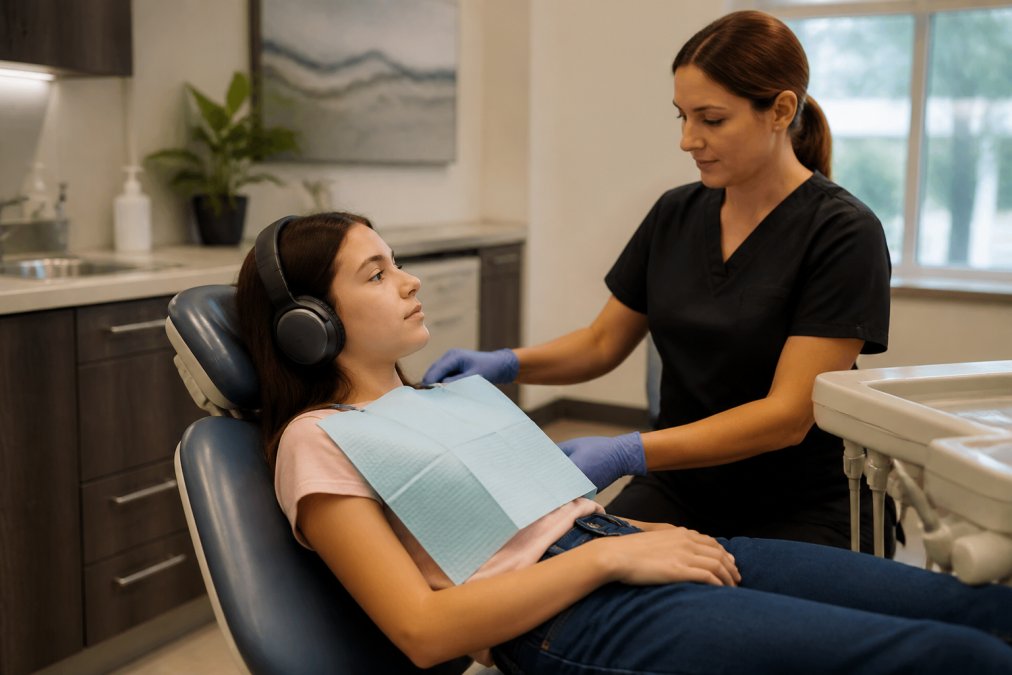
- Auditory, the drill, the suction, the ultrasonic scaler, background radio, and hallway chatter. Counter with noise-canceling headphones, earplugs, or a single familiar audio track played at a fixed volume.
- Visual, the overhead operatory light, the bright white walls, fluorescent flicker, and the tray of instruments in peripheral view. Counter with sunglasses, a dimmed light, and a cloth or towel over the instrument tray.
- Tactile and proprioceptive, the bite block, the suction tip, cold water spray, and the sensation of lying flat with no sense of where your body ends. Counter with a weighted lap pad, a rolled towel under the knees, and a hand signal that pauses everything.
What a Sensory-Friendly Visit Actually Includes
A sensory-friendly visit often includes:
- A quiet room away from the main waiting area, or a car-side check-in so you wait outside
- Dimmed overhead lights and sunglasses for glare
- Noise-canceling headphones or earplugs
- A weighted blanket or lap pad
- A stop signal you can raise at any moment
- Shorter appointment blocks with breaks
- A written or visual schedule of what happens next, in order
- The option to skip the polishing paste or the fluoride varnish if the taste is a trigger
The stop signal matters most: knowing you can pause lowers fear before it starts. Agree on the exact signal (a raised hand, a squeeze of the armrest, a word) and confirm the dentist will stop within seconds, not at the end of the next step.
How to Ask for Accommodations Without Over-Explaining
You do not need a diagnosis letter, a short, specific request beats a long explanation. When you book, say: "I have ADHD and sensory sensitivities. I need the first appointment of the day, a quiet room, and a stop signal I can use. Can you note that on my file?"
When a General Practice Is Not Enough
Some patients need more than a quiet room. If you require sedation, deep scaling under anaesthetic, or a team trained in behavioural support, ask whether the practice has a dentist who focuses on special needs dentistry or patient-centred care for neurodivergent adults and children. If not, ask for a referral, the goal is a clinician who adapts the pace and plan around you.
How to Prepare for a Dental Appointment With ADHD
Preparation is the best way to lower anxiety before you walk in. The goal: fewer surprises and a clear plan.
What You'll Need
- A short written list of your questions
- Your medication names and doses
- Noise-canceling headphones
- A support person, if that helps you
Step 1: Book the Right Slot [Time: 5 minutes]
Ask for a morning appointment and mention your ADHD when booking. Say you need extra time and a quieter room.
Step 2: Visit Before Your Appointment [Time: 10 minutes]
A quick tour on a calm day removes the unknown; many practices will arrange this.
Step 3: Write Your Questions Down [Time: 10 minutes]
Bring a note with your three biggest concerns. Hand it to the dentist at the start. This takes pressure off your working memory.
Step 4: Agree on a Stop Signal [Time: 2 minutes]
Pick a hand signal. Raise it and everything pauses. No explanation needed.
Step 5: Plan Your Reward [Time: 2 minutes]
Line up something good for after. A coffee, a show, a walk. It gives your brain a finish line.
Expected Result: A shorter, calmer visit with fewer surprises and less dread beforehand.
Dental Hygiene Tips for ADHD That Actually Stick
Most oral hygiene routines are built for neurotypical brains. Build one that fits how you actually function, using executive-function tools that work elsewhere in your life.
Start With the Mechanism, Not the Tip
Brushing fails for three reasons, and each one needs a different fix:
- Initiation failure, you know you should brush, but you cannot start. Fix: shrink the first step until it is almost nothing. "Pick up the brush" is the task. Brushing follows.
- Sustaining failure, you start, then lose track of time or get bored. Fix: externalize time with a visual timer or an electric brush that shuts off on its own.
- Remembering failure, the task never enters working memory. Fix: attach it to something you already do without thinking.
Habit Stacking: Attach Brushing to an Existing Anchor
Habit stacking borrows the cue from a behaviour you already perform automatically. The formula: after [existing habit], I will [new habit].
Strong anchors for ADHD brains:
- After I take my morning medication, I will brush.
- After I start the shower, I will brush (keep a second brush in the shower).
- After I set my coffee to brew, I will floss with a pick.
- After I plug in my phone at night, I will brush for two minutes.
Visual Timers Beat Phone Alarms
A phone alarm is easy to dismiss and pulls you into the screen. A visual timer, a sand timer, a countdown clock, or the timer built into an electric toothbrush, shows time passing without language, which matters because time blindness is about not feeling duration, not about not knowing the number.
Sensory-Friendly Toothpaste and Tools
If the taste or texture of toothpaste is the reason you avoid brushing, change the toothpaste, not yourself. Options that work for many patients:
- Unflavoured or mild-flavoured toothpaste, no strong mint, no burning sensation
- Low-foaming formulas, less of the fizzy, filling-the-mouth feeling that triggers gagging
- Children's toothpaste with fluoride, milder flavour, still provides cavity protection when it carries fluoride
- Fluoride mouthwash as a backup, on days brushing does not happen, a rinse still delivers fluoride
Body Doubling and the Two-Minute Rule
Body doubling, doing a task alongside another person, in person or on a call, raises follow-through for many people with ADHD. A video call where you both brush, or a household member at the same sink, is enough. The two-minute rule covers the days you cannot face the full routine, set a timer and do whatever you can.
The Backup Toolkit for Bad Days
Keep these within arm's reach so a bad day does not become a bad week:
- Disposable floss picks on the counter, not in a drawer
- A water bottle at your desk to keep saliva moving
- Sugar-free gum with xylitol for between-meal chewing
- A spare brush and paste at work or in your bag
- Fluoride mouthwash for the days brushing does not happen
| Problem | Quick Fix | Why It Works |
|---|---|---|
| Cannot start | Shrink the first step to "pick up the brush" | Removes initiation friction |
| Lose track of time | Visual sand timer or brush with quadrant timer | Externalizes duration |
| Forget entirely | Habit stack on medication or shower | Borrows an existing cue |
| Taste or texture aversion | Unflavoured, low-foam, fluoride toothpaste | Removes the sensory trigger |
| Flossing skipped | Floss picks on the counter | Cuts steps to one |
| Dry mouth | Water bottle at your desk | Keeps saliva moving |
| Dread before visits | Stop signal agreed in advance | Restores a sense of control |
Book Cleanings Every Six Months
Home care will slip, not a failure but a predictable part of ADHD. Professional cleanings every six months are the safety net that catches what home care misses. If six months is hard to remember, book the next appointment before you leave and ask for a reminder text or email a week before.
Breaking the Dental Shame Cycle
Shame is the biggest reason people with ADHD avoid the dentist, and avoidance makes everything worse. The cycle: you miss brushing, feel ashamed, skip the dentist, problems grow, and the shame deepens. The shame is not protecting you, it is the thing keeping you out of the chair.
Conclusion
Avoiding the dentist because of ADHD or anxiety is common, and it is fixable. The right practice adjusts the room, the pace, and the plan to fit how your brain works. Pearly Curve Dentistry offers modern treatments, expert support, and comfortable care designed to help every patient achieve a healthier, more radiant smile.
Frequently Asked Questions
Do people with ADHD have more dental problems?
Yes, research suggests that individuals with ADHD may face higher rates of tooth decay, gum disease, and enamel erosion. This is often due to executive dysfunction making consistent oral hygiene routines difficult, stimulant medication causing dry mouth (xerostomia), and bruxism (teeth grinding) being more common. Sensory sensitivities can also make brushing and flossing uncomfortable, leading to skipped sessions. Regular preventative care and ADHD-friendly strategies can help manage these risks.
How can a dentist accommodate patients with ADHD?
A dentist can accommodate patients with ADHD by offering shorter appointment durations, providing clear communication and visual aids, and creating a sensory-friendly environment with reduced noise and lighting. They may also use positive reinforcement techniques and behavioral management strategies. Sedation dentistry options, such as nitrous oxide, can help patients who experience severe dental anxiety. It's important to discuss your specific needs with the dental team beforehand so they can tailor the visit to your comfort.
What strategies help reduce sensory overload during dental cleanings?
To reduce sensory overload during dental cleanings, try scheduling appointments at quieter times, bringing noise-canceling headphones or sunglasses, and agreeing on a hand signal to pause treatment. Some offices offer weighted blankets or fidget tools. Discussing your sensory triggers with the hygienist in advance allows them to adjust water spray, suction, and polishing techniques. A patient-centered approach that respects your boundaries can make the experience much more manageable.
How should I prepare my child with ADHD for a dental appointment?
Prepare your child with ADHD for a dental appointment by using social stories or visual schedules to explain what will happen. Visit the office beforehand if possible, and practice relaxation techniques like deep breathing. Pack a comfort item and keep the appointment time short. Clear communication with the dental team about your child's triggers and preferences is key. Positive reinforcement, such as a small reward after the visit, can build a more positive association with dental care.