 comparison
Dental Bridge vs Implant Cost: 2026 Guide
Table of Contents
- Dental Bridge vs Implant: What Each Option Actually Is
- Dental Bridge vs Implant Cost: A Full Breakdown
- Pros and Cons: Bridges and Implants Side by Side
- Dental Bridge Lifespan vs. Implant Durability
- Dental Implant Recovery Time and Procedure Timeline
- Dental Insurance Coverage for Tooth Replacement
- Which Tooth Replacement Option Is Right for You?
- Frequently Asked Questions
Last Updated: August 22, 2026
Dental Bridge vs Implant: What Each Option Actually Is
The dental bridge vs implant cost question is one of the most common decisions patients face after tooth loss. At Pearly Curve Dentistry, we walk patients through this decision regularly, and the upfront number almost never tells the full story. Understanding what each option actually is, how it works, and what it costs over a decade or more changes the calculus entirely.
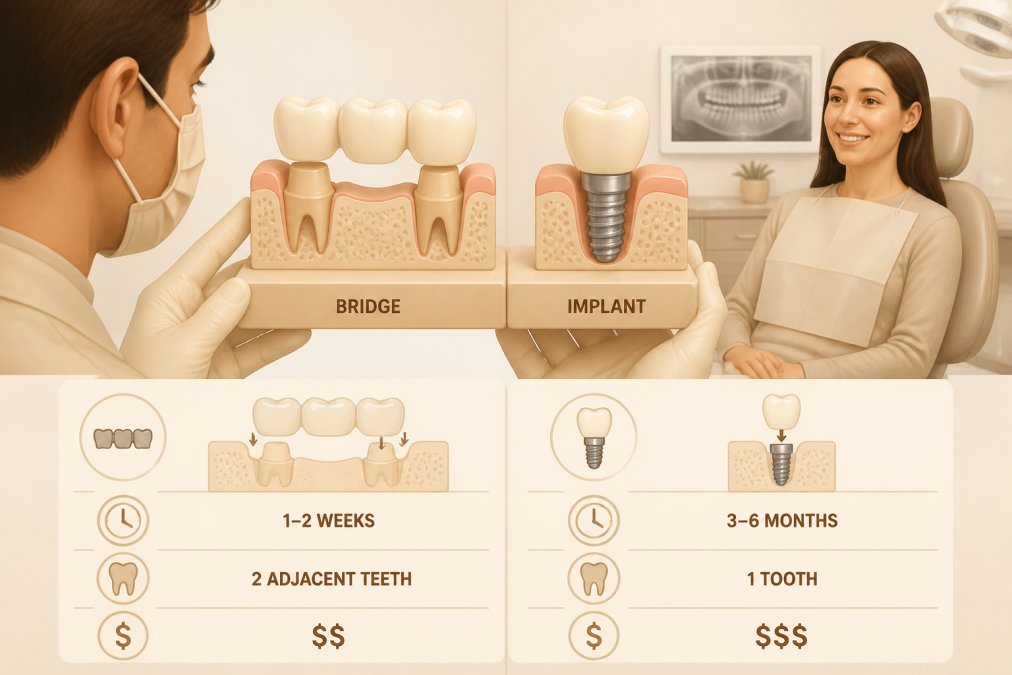
Both options fall under restorative dentistry and serve the same core purpose: replacing missing teeth to restore bite force, speech, and appearance. But they achieve that goal through fundamentally different mechanisms, with very different implications for your long-term oral health.
How a Traditional Dental Bridge Works
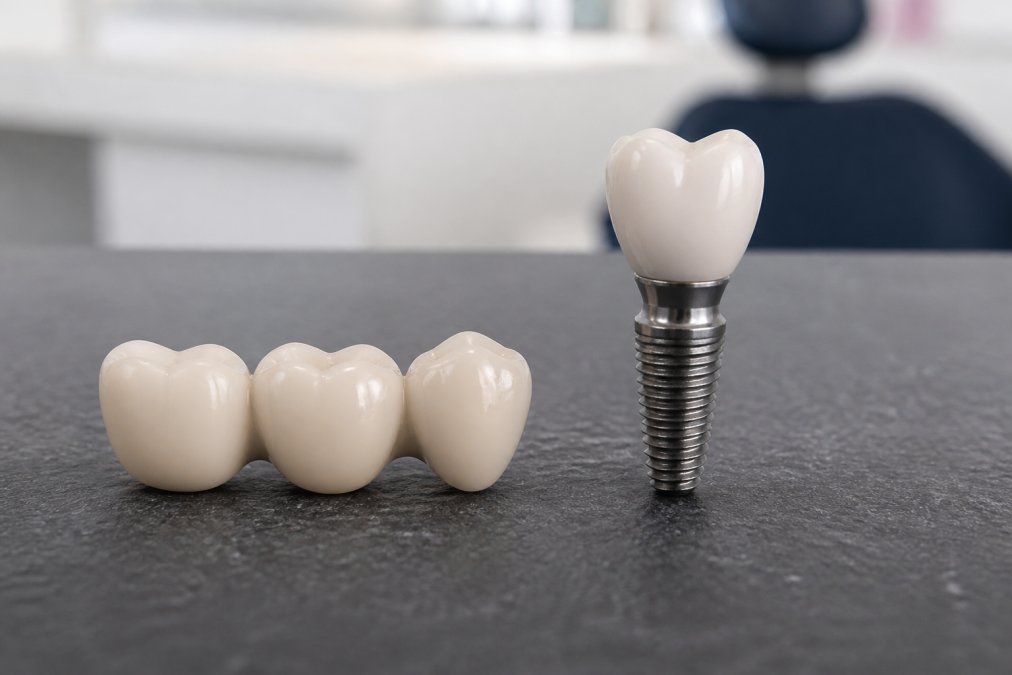
Adental bridge is a fixed prosthetic that spans the gap left by a missing tooth. It consists of one or more artificial teeth, called pontics, fused between two dental crowns that are cemented onto the natural teeth on either side of the gap, called abutment teeth.
The critical detail most patients miss: those abutment teeth must be filed down significantly to accommodate the crowns. This is irreversible. Healthy tooth structure is permanently removed to anchor the bridge. The procedure is typically completed in two to four weeks, requiring two dental visits. According to Canadian Dental Association's patient guide on bridges, bridges are typically made from porcelain, ceramic, or a combination of materials, and are permanently cemented in place.
How a Dental Implant Works
A dental implant is an artificial tooth root, typically a small titanium post, surgically inserted into the jawbone. Once placed, the jawbone gradually fuses to the titanium through a process called osseointegration. After healing, a custom crown is attached to the implant via a connector piece called an abutment.
The implant functions independently. It does not touch or alter adjacent teeth and stimulates the jawbone the way a natural tooth root does, preventing the bone loss that follows tooth extraction. The treatment timeline is longer, typically four to nine months from placement to final crown, because osseointegration takes time. Some patients with low bone density require bone grafting before implant placement, which adds additional time and cost.
Dental Bridge vs Implant Cost: A Full Breakdown
The dental bridge vs implant cost comparison looks very different depending on whether you examine year one or year twenty.
Upfront Costs vs. Total Cost of Ownership
That gap feels significant at the outset, but the lifespan difference changes the math.
A bridge typically lasts 10 to 15 years before requiring replacement. An implant, with proper care, can last many years longer, often a lifetime. Over a 20-to-30-year period, a patient who replaces their bridge once or twice may spend considerably more in total than a patient who chose an implant from the start.
| Factor | Dental Bridge | Dental Implant |
|---|---|---|
| Starting cost (CAD) | See website for pricing | See website for pricing |
| Typical lifespan | 10-15 years | Many years, potentially lifetime |
| Adjacent teeth affected | Yes (filed down) | No |
| Jawbone preservation | No | Yes |
| Replacement needed | Likely | Unlikely with proper care |
| Treatment timeline | 2-4 weeks | 4-9 months |
| Bone grafting required | No | Sometimes |
Hidden Costs: Bone Grafting, Replacements, and Adjacent Tooth Risk
Three cost factors are routinely underestimated in basic dental bridge vs implant comparisons.
Bone grafting: If your jawbone has experienced resorption after tooth loss, you may not have sufficient bone density to support an implant without a bone grafting procedure first. Grafting adds to the overall cost and extends the timeline.
Bridge replacement: When a bridge fails, the abutment teeth underneath must be re-evaluated. In many cases, the supporting natural teeth have experienced decay or structural weakening during the bridge's lifespan, complicating the replacement procedure and increasing its cost.
Adjacent tooth risk: The two abutment teeth supporting a bridge are permanently altered and become more vulnerable to decay and fracture over time. If either abutment tooth fails, the entire bridge fails with it.
Pros and Cons: Bridges and Implants Side by Side
Dental Bridge: Pros
- Lower upfront cost
- Faster treatment timeline, often complete within a month
- No surgery required
- Effective for patients who are not implant candidates due to bone density issues
- Restores smile, chewing function, and speech reliably
Dental Bridge: Cons
- Requires permanent alteration of healthy adjacent teeth
- Does not prevent jawbone resorption beneath the pontic
- Average lifespan of 10-15 years means likely replacement
- Abutment teeth become structurally vulnerable over time
- More demanding oral hygiene around the bridge area
Dental Implant: Pros
- Does not alter or damage adjacent healthy teeth
- Preserves jawbone density through osseointegration
- Closely mimics the look, feel, and function of a natural tooth
- Long-term durability makes it the stronger total cost of ownership option for most patients
- Easier to clean; no special flossing tools required
Dental Implant: Cons
- Higher upfront cost
- Requires a surgical procedure under local anesthesia
- Longer recovery period and overall treatment timeline
- May require bone grafting if bone density is insufficient
- Not suitable for patients with certain systemic health conditions or active periodontal disease
Dental Bridge Lifespan vs. Implant Durability
A traditional bridge typically lasts 10 to 15 years. With meticulous oral hygiene and regular dental visits, some bridges last longer, but the abutment teeth underneath are always accumulating wear and risk. When a bridge fails, the replacement procedure is more complex than the original because the abutment teeth have been altered and may have deteriorated.
Dental implant durability is considerably stronger. The titanium post itself rarely fails once osseointegration is complete. The crown on top may require replacement after many years of use, but the implant structure beneath often remains intact indefinitely. According to Canadian Dental Association's overview of implant procedures, implants are designed to look and function like natural teeth and contribute to long-term oral health by preventing bone loss.
The real durability advantage of implants is the protection it provides to surrounding bone and tissue. Jawbone resorption under a bridge pontic is a slow, progressive process that creates future problems: shifting teeth, changes in facial structure, and complications if you ever decide to pursue an implant later.
Dental Implant Recovery Time and Procedure Timeline
Dental implant recovery time is the most common reason patients choose a bridge instead, and it is worth understanding exactly what that timeline involves before making that trade-off.

The implant process typically unfolds across several stages. First, the implant post is surgically placed into the jawbone under local anesthesia, usually taking one to two hours. After placement, osseointegration, where bone tissue gradually bonds to the titanium surface, takes roughly three to six months depending on bone density and overall health.
Once osseointegration is confirmed, an abutment connector is attached, and impressions are taken for the custom crown. The final crown is placed a few weeks later. Total timeline: four to nine months for most patients. For those requiring bone grafting beforehand, add another three to six months.
Most patients experience some swelling and discomfort in the first few days after surgery, controlled with over-the-counter pain management and dietary modifications. The gum tissue heals relatively quickly. The longer wait is simply biology: bone integration cannot be rushed.
A bridge, by comparison, involves two appointments over two to four weeks with no surgical procedure and no extended healing phase. For patients who need tooth replacement quickly, such as those replacing a visible front tooth before a significant life event, the bridge timeline is a genuine practical advantage.
Dental Insurance Coverage for Tooth Replacement
Most Canadian dental benefit plans classify bridges under major restorative services, typically covered at 50% after the deductible, up to the plan's annual maximum. Implants, however, are frequently excluded from coverage or classified as cosmetic procedures, depending on the insurer and the specific plan.
Before committing to either treatment, ask your dentist to submit a pre-determination to your insurer. The insurer will respond with exactly what they will cover, what codes they are applying, and what your out-of-pocket expenses will be.
Insurance coding matters more than most patients realize. A bridge is typically coded as a major restorative procedure. An implant crown may be coded differently than the implant post itself, and some plans cover the crown but not the surgical placement. Understanding how each component is coded can significantly affect your reimbursement.
For patients without dental insurance or with plans that exclude implants, financing options exist. Beautifi, a Canadian dental financing provider, offers flexible monthly payment plans for procedures over $1,000 CAD, with terms ranging from six months to six years and an online application process. According to Beautifi's dental financing overview, eligible applicants may qualify for rates as low as 0%, with no prepayment penalties.
Which Tooth Replacement Option Is Right for You?
For most patients with adequate bone density and no contraindications, a dental implant is the stronger long-term choice. The dental bridge vs implant cost gap narrows significantly when you account for bridge replacement cycles, adjacent tooth risk, and the ongoing consequences of jawbone resorption.
Choose a dental bridge if:
- You need tooth replacement quickly and cannot wait four to nine months
- You do not have sufficient bone density for an implant and are not a candidate for bone grafting
- Upfront cost is the primary constraint and you understand the long-term trade-offs
- The teeth adjacent to the gap already have large restorations or crowns
Choose a dental implant if:
- You have adequate bone density or are willing to undergo bone grafting
- You want to preserve adjacent healthy teeth
- You are planning for long-term oral health and view the procedure as a lasting investment
- You want the option that most closely mimics a natural tooth in function and feel
Systemic health conditions, medications, bone density, and periodontal health all affect which option is clinically appropriate for you. A thorough treatment plan consultation, including imaging to assess bone density, is essential before making this decision.
The Canadian Dental Association's patient resources on oral health procedures offers a useful starting point for understanding both procedures before your consultation.
| Patient Situation | Better Option |
|---|---|
| Needs fast treatment | Bridge |
| Limited bone density, no grafting | Bridge |
| Healthy adjacent teeth | Implant |
| Long-term cost priority | Implant |
| Wants to preserve jawbone | Implant |
| Already crowned abutment teeth | Bridge may be appropriate |
| Adequate bone, no systemic contraindications | Implant |
Choosing between a dental bridge and an implant is one of the more consequential decisions in restorative dentistry, and it deserves more than a quick cost comparison. At Pearly Curve Dentistry, we approach this conversation with transparency: we walk through the clinical picture, the long-term cost of ownership, and the trade-offs honestly, so you can make a decision that serves your oral health for years to come. If you are weighing your tooth replacement options, book a consultation with our team to get a personalized treatment plan built around your specific needs.
Frequently Asked Questions
Q: Is it better to get a tooth implant or a bridge for long-term health?
A: For long-term oral health, implants generally have the advantage. A dental implant preserves jawbone density through osseointegration, preventing the bone resorption that occurs after tooth loss. It also leaves adjacent teeth untouched. A bridge, by contrast, requires filing down the neighboring teeth and does not address jawbone loss beneath the pontic. However, the right choice depends on your bone density, overall periodontal health, budget, and treatment timeline. A dentist can assess your candidacy and help you weigh both options properly.
Q: Does provincial health insurance cover dental implants or bridges in Canada?
A: Provincial health plans generally do not cover dental implants or bridges for adults, as these are considered restorative or prosthetic procedures outside most public benefit schedules. Private dental insurance plans vary widely: many cover a portion of bridge costs under major restorative benefits, but implants are frequently excluded or subject to strict annual maximums. Submitting a pre-determination to your insurer before treatment begins is the most reliable way to confirm what your specific plan will cover and avoid unexpected out-of-pocket expenses.
Q: Which is more painful: the procedure for a bridge or an implant?
A: Both procedures are performed under local anesthesia, so neither should be painful during treatment. Post-procedure, implant surgery typically involves more soreness and swelling in the days following placement, given that it is a surgical procedure involving the gum tissue and jawbone. Bridge preparation causes less immediate post-procedure discomfort, though the filing of adjacent teeth is irreversible. Most patients manage post-implant discomfort with over-the-counter pain relief. Your dental team will give you specific aftercare instructions based on your treatment plan.
Q: Why do some dentists not recommend a dental bridge?
A: Dentists may advise against a bridge when the adjacent teeth are healthy and structurally sound, since preparing them as abutments requires permanently removing enamel. Over time, those teeth become more vulnerable to decay and fracture. Bridges also do not prevent jawbone resorption beneath the gap, which can affect the fit and appearance of the prosthetic over time. For patients with sufficient bone density and no contraindications to surgery, an implant preserves more of the natural tooth structure and supports better long-term periodontal health.
Q: How can I finance a dental implant or bridge if I don't have insurance?
A: Several Canadian financing providers, including Beautifi, offer monthly payment plans for dental procedures starting at $1,000 or more, with terms ranging from six months to six years. Some applicants qualify for low or zero-interest rates depending on their credit profile. Applying typically involves a quick online process with no impact on your credit score just for checking eligibility. Ask your dental office about available financing partners and whether a phased treatment plan could help spread costs over time.